
Call Us On

+244 974 444 114

   Email Us

info@islluanda.com
admission@islluanda.com
hr@islluanda.com

   Our Location

Rua Dos Camarotes, Futungo De Belas,
Talatona Luanda, Angola

ISL PRIMARY FRAMEWORK

  • Holistic Development
  • Evolves Learner Attributes
  • Skills and Understanding Based Progressive learning
  • Global Relevance
  • Creative and Innovative Mindset
  • Moral and Ethical Values
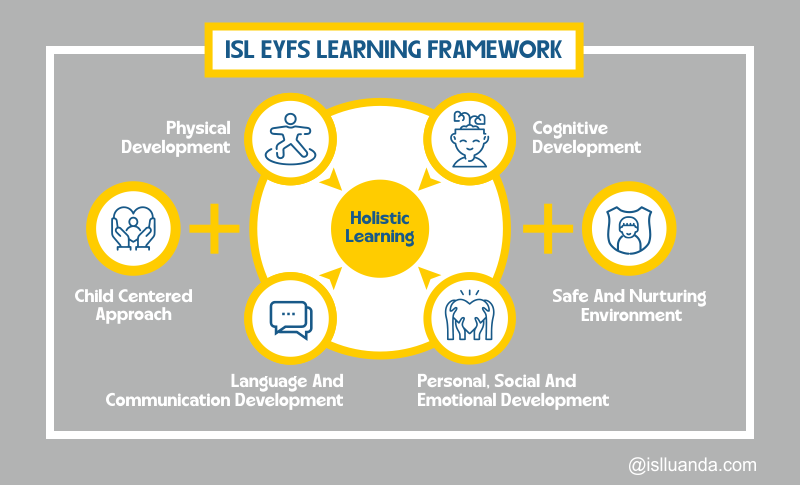
  • Cognitive Development
  • Language And Communication Development
  • Personal, Social, and Emotional Development
  • Child Centered Approach
  • Safe And Nurturing Environment
ISL-learning-framework
Holistic Development

ISL Primary starts learners on an exciting educational journey. It provides a strong foundation for students at the beginning of their schooling before progressing through the effective Pathway in an age-appropriate way.

  • Nurture learners’ intellectual, physical, emotional, and creative growth.
  • Encourage participation inoptional subjects like Art, Music, Digital Literacy, Global Perspectives, and PE.
  • Balance academic achievement with personal and social growth.
  • Personal Social & Emotional Development of child :Social & Emotional Development – Builds confidence, resilience, and positive relationships through interactions with peers and adults.
Evolving Learner Attributes

the ISL Learner Attributes are at the heart of the ISL Primary Pathway. They describe the qualities that Cambridge wants learners to develop to succeed in school, higher education, and life. Here are the five ISL Learner Attributes:

  • Confident: Ready to take risks, communicate effectively, and handle new challenges.
  • Responsible: Show respect, teamwork, and global citizenship.
  • Reflective: Reflective: Evaluate strengths and areas for improvement.
  • Innovative: Apply creativity and problem-solving.
  • Engaged: Actively participate in learning and community life.
Child-Centered Approach

Learner Attributes are at the heart of the ISL Primary Pathway . They describe the qualities that ISL wants learners to develop to succeed in school, higher education, and life.Here are the five ISL Learner Attributes:

  • Personalized Learning : Activities and lessons are adapted to each child's interests, abilities, and pace of development.
  • Learning Through Play : Play is the foundation of EYFS, allowing children to explore, experiment, and develop skills naturally.
  • Encouraging Independence : Children are given opportunities to make choices, solve problems, and develop confidence in their abilities.
  • Supporting Individual Needs : Recognizes that each child develops at their own rate and provides targeted support for different learning styles and abilities.
  • Positive Relationships : Strong focus on building secure and trusting relationships with adults and peers to enhance emotional well-being.
  • Inclusive Environment : ISL Primary Framwork promotes equality and diversity, ensuring all children, regardless of background or ability, feel valued and supported.
  • Encourages learning through :active engagement for better exploration and experience.
Activity Based Learning (ABL)

Activity-Based Learning (ABL) is especially effective at the primary level because children (ages 5–11) learn best through hands-on, engaging experiences rather than passive listening.ABL is a child-centered approach where students learn through practical activities, games, projects, and real-life experiences.Instead of just memorizing, learners do, explore, and reflect — making learning meaningful and long-lasting. Here’s a structured explanation:

  • Learning by Doing : children actively participate, not just listen.
  • Experiential & Hands-On :concepts are taught through activities, experiments, and projects.
  • Sensory Play :Engages the senses (touch, sight, sound, smell, and taste). Helps with language development and cognitive growth. Example: Playing with sand, water, or textured materials.
  • Role-Play & Imaginative Play :Encourages creativity and social interaction. Helps children understand real-world roles and emotions. Example: Pretending to be a doctor, teacher, or shopkeeper.
  • Outdoor Play & Physical Play : Supports gross motor skills, health, and well-being. Encourages exploration and risk-taking in a safe way. Example: Climbing, running, playing with a ball, or digging in the mud.
Areas of Learning

Primary Education (ages 5–11, Stages 1–6), learning is structured around a broad and balanced framework. It includes prime (core) areas of learning and specific (additional/optional) areas of learning, very similar to how holistic early and primary education models are built.

Prime Areas of Learning

The Prime Areas are the foundation for all learning and development. They focus on essential skills that children need for future learning. These areas are crucial in the early years because they lay the groundwork for children to develop skills in more complex areas later on.
  • English :(Grammar, Written Expression, Comprehension, Phonics, Reading)Build strong communication and literacy skills. Develop ability to read with fluency and comprehension. Strengthen grammar and vocabulary for clear expression. Encourage creative and critical writing. Foster confidence in speaking and listening.
  • Portuguese :Develop bilingual/multilingual communication. Build reading, writing, listening, and speaking skills in Portuguese. Foster appreciation of literature, culture, and heritage.
  • Mathematics :Build numeracy skills (addition, subtraction, multiplication, division). Develop problem-solving and logical reasoning. Understand shapes, measurements, time, data handling, and patterns. Apply mathematics in everyday life situations.
  • Science :Nurture curiosity and inquiry skills. Understand the natural and physical world. Encourage experimentation and observation. Develop scientific reasoning and awareness of sustainability/environment.
  • Global Perspectives : Encourage critical thinking and collaboration. Explore real-world issues like environment, community, culture, health. Foster intercultural understanding and global citizenship.
  • Humanities : Develop awareness of history, geography, and society. Understand cultural diversity and respect for different communities. Encourage responsibility towards heritage, environment, and civic life.
  • ICT (Information & Communication Technology) : Build digital literacy and safe use of technology. Develop skills in basic coding, word processing, and presentations. Encourage use of ICT as a tool for creativity, research, and problem-solving.

Co-Curricular Subjects

Co-Curricular Subjects (like Music, Art, and Physical Education in Primary Education) are often seen as “extra,” but in reality, they are essential for holistic learning. They complement the core subjects by developing creativity, social skills, physical wellbeing, and emotional intelligence.
  • Music :Develop listening, rhythm, and performance skills. Encourage self-expression and creativity through sound. Foster appreciation of musical traditions and cultures.
  • Arts :Develop visual expression and creativity. Build skills in drawing, painting, craft, and design. Encourage innovation and imagination through art. Foster appreciation of aesthetics and cultural art forms.
  • Physical Education (PE) :Promote physical fitness, health, and wellbeing. Develop coordination, strength, and motor skills. Encourage team spirit, discipline, and sportsmanship. Instill lifelong habits of exercise and healthy living.